










The Trump administration told the Supreme Court Monday morning it still wants to block a federal judge’s order mandating that the administration pay 42 million Americans their full SNAProgram benefits for November during the government shutdown.
SNAP, which stands for the Supplemental Nutrition Assistance Program, provides food benefits to low-income households to supplement their grocery budget.
With SNAP, people who receive benefits are able to purchase much-needed grocery items such as fruits, vegetables, meat, poultry, fish, dairy products, breads, cereals, snack foods, non-alcoholic beverages and even seeds and plants, which could be used to produce food for the household to eat.
However, this does not only affect families who received SNAP benefits prior to the government shutdown. According to Ohio Benefits Self Service Programs, any individual may qualify for SNAP if their household’s gross monthly income is at or below 130% of the federal poverty guidelines.
So, what does this mean for the approximately 1.4 million Ohioans who relied on SNAP?
Well, according to the Ohio Department of Job & Family Services, Gov. Mike DeWine ordered them to distribute $7 million to eight regional food banks. DeWine had also ordered $18 million in emergency relief to be given to over 63,000 Ohioans, however, due to recent federal court action, the emergency relief fund for SNAP benefits has been delayed until further notice.
For Kent students who may have relied on SNAP and other government benefits, on-campus support is available through the Crisis Advocacy Resources Education Support Center.
“The CARES Center focuses on four basic needs of our students, which include financial empowerment, food security, housing stability and mental well-being,” says Ken Ditlevson, the CARES Center director. “Through the CARES Center, students can access two on-campus food pantries. Additionally, we have two case managers who can help students that are struggling with financial crises, such as facing homelessness, utility shutoff or lacking funds for course supplies.”
According to Ditlevson, the CARES Center website outlines the process for accessing services, which differs between seeking food security assistance and meeting with a case manager.
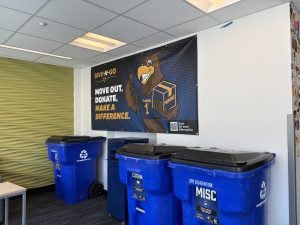
For students seeking food security assistance, Ditlevson states that there are two options. The first is that students can fill out the CARES Center Food Pantry Registration form and then stop by the food pantry (located in Kent Student Center, suite 106), which operates Mondays through Fridays from 10:30 a.m. – 4 p.m.
Students can also schedule an appointment to access the Flashes Fighting Hunger food pantry, which is open to all students, staff, faculty and community members. The Flashes Fighting Hunger food pantry operates on Tuesdays and Fridays from 3 p.m. – 6 p.m. and 5 p.m. – 6 p.m. for people without an appointment.
“The CARES Center also coordinates ‘Swipe Out Hunger,’ which permits current KSU students to request two emergency food swipes [per semester] for emergency meals at either Eastway or the DI Hub,” Ditlevson says. “This can be accomplished through Flashline. Students can also donate up to two swipes per semester to help another KSU student.”
Sam Canter, a sophomore human development and family science major, is one of the many students who have previously visited the CARES Center’s food pantry.
“I was unable to afford groceries, which is still true,” Canter says. “I rely on the university’s dining halls and my meal plan for food. This can be especially difficult when I want to eat something like broccoli or fruit because many of the veggies and fruit offered are nearing the end of their shelf life.”
Overall, Canter says his experience with the food pantry was positive, though he ran into some of the same problems he experienced before with his meal plan.
“I felt that I couldn’t take much more than I could eat in a day because I was worried about spoiling. I got a cantaloupe and it went bad within two days,” Canter says. “I was surprised that they offered little sheet cakes, though, which was definitely my favorite of what they offered. It also gave me access to fruits and veggies, and I appreciated that.”
For students who wish to access case manager services, Ditlevson says that students need to complete the Basic Needs Assistance form. Once the form is completed, students will receive an email from a case manager within one business day, who will then work with the student to schedule a meeting with them.
“I am thankful that we have the CARES Center to help prevent our students from falling through the cracks, which might block them from reaching graduation,” Ditlevson says. “The CARES Center is a safety net to help support our students and overall Flash community, which helps hundreds of students each year.”
Rhys Wright, a junior special education and disability services major and career peer at the Career Center, says he wants Kent State students to know that resources like the CARES Center are made for students and that they should use them.
“If you’re unsure about using a resource because you don’t want to take it from someone else, know that people using those resources is how the organizations are able to advocate for more funding and a larger reach,” Canter says. “Use them, even if you might not need it. Use it, even if you just want something small. You’re helping them grow.”
For students who wish to get involved with the CARES Center, volunteers can sign up for one-hour shifts through Helper Helper or email [email protected] to discuss any interests in being an intern, practicum student or student employee.
The CARES Center is also currently in need of non-perishable food items for its food pantry. These items include canned chicken, canned tuna, pasta and sauce, cereal and shelf-stable milk, canned fruit, shampoo, body wash, toothpaste and other items that can be found on the CARES website.
Rebekah Hiles is a web writer and photographer. Contact her at [email protected].