








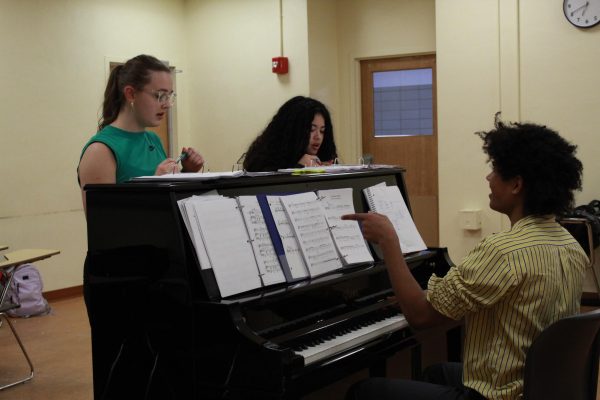
On a Wednesday night, during the first few weeks of rehearsal ahead of their April performances, the cast of “Madame Bovary: A New Musical” is still counting time signatures under their breath.
At the front of the room, Randolph McFarren leans forward over the piano, listening closely. The musical — his original adaptation of Gustave Flaubert’s 1857 novel — is early in the process, and it shows in the best possible way. Original productions happen minute by minute and note by note.
By the time rehearsal began this semester, McFarren had already been living with “Madame Bovary“ for nearly three years. The idea started as far back as eighth grade when he read the novel.
“I was more enamored by the romance and drama,” McFarren says. “What started as a simple adaptation turned into an exploration of human desire, class struggles and an exploration of dreams and ambitions.”
In Flaubert’s novel, Emma Bovary’s longing lives mostly in her thoughts — her hunger for romance, luxury and escape. When taken to the stage, these thoughts must become action. They must become music. Translating that interior life into performance was one of the central creative challenges for McFarren.
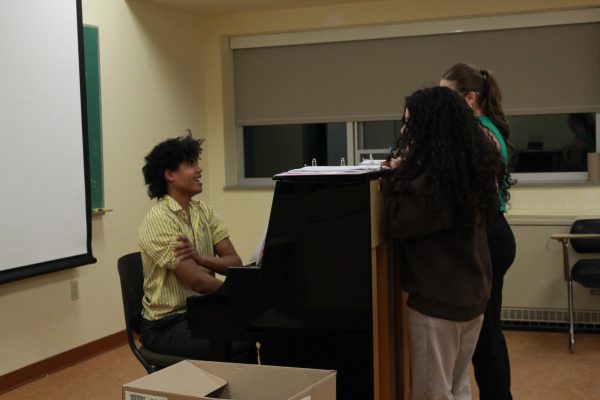
The turning point came unexpectedly; McFarren recalls dreaming about one of the numbers — a piece that would later become “Let The Moment Go.” He woke up and went straight to the piano.
That was the moment he knew he wasn’t just considering the project.
“It stopped being just about adapting the book,” McFarren says. “It became about asking why some dreams can come true and others simply can’t.”
Themes of aspiration and limitation sit at the center of the musical. Rather than treating desire as purely personal, the production frames longing within social and material boundaries.
While the original novel critiques illusion and desire, McFarren’s interpretation explores how class and economic status influence what individuals are able to pursue or achieve.
“Some dreams can come true, but delusions simply can’t,” he says. “Economic status plays a huge role in possibility — in who gets to chase something and who doesn’t.”
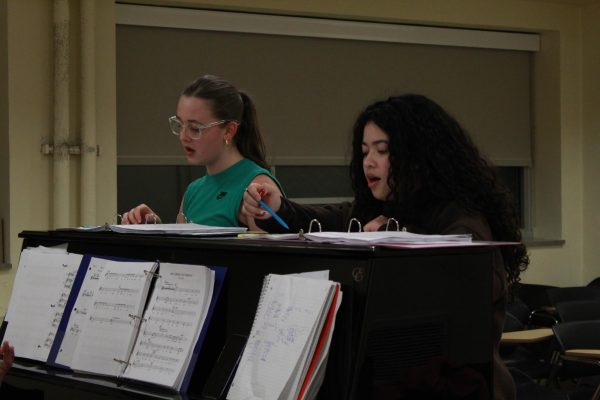
For McFarren, one of the most surreal moments has been hearing his music performed live. He had the opportunity to create the piece for Kent State’s student production series, building something ambitious within a space designed to support emerging artists.
“Goosebumps,” he says. “It’s rare to see people enjoy something that was just in your head. When the cast starts singing and it clicks — or when a song gets stuck in someone’s head — that’s everything.”
Costume designer and fellow Kent State student Tori Collins, a senior with a major in theatre design, tech and production, approached the production with a similarly collaborative mindset. Having connections with the director and previous experience on a black box show, she says seeing his determination made the opportunity feel like joining a passion project in motion.
“Watching his past work and knowing how driven he is made me excited to be part of something on a bigger scale,” Collins says.
Her design concept centers on building a visual world out of found materials. Using repurposed objects, she aims to evoke the silhouette of the historical period from a distance while maintaining a modern sensibility up close.
“The world is built from trash,” Collins says. “We’re pulling from Randolph’s words and shaping that into the scenes. It gives the outline of the time period while still building something contemporary.”
Small details reinforce the production’s ethos of transformation and reuse. Jewelry pieces incorporated into the costumes are upcycled and thrifted, many created by Haley Ferguson, Collins’ roommate and owner of FullCircle Jewelry Co. These subtle touches deepen the worldbuilding and visual storytelling very intentionally.
As the rehearsal wraps for the night, the room shifts from focused repetition to quiet unwinding. The final notes of a duet linger longer than before, suspended in the space. The sound fills the space with a confidence that is a signal for something compelling unfolding.
The finished production of McFarren’s “Madame Bovary“ will take the stage on April 24 and 25 at 7 p.m. in Oscar Ritchie Hall, inviting audiences to witness a classic story transformed.
Kat Thomas is a writer. Contact her at [email protected]